Field Notes
Share:
Copy link
Copied!
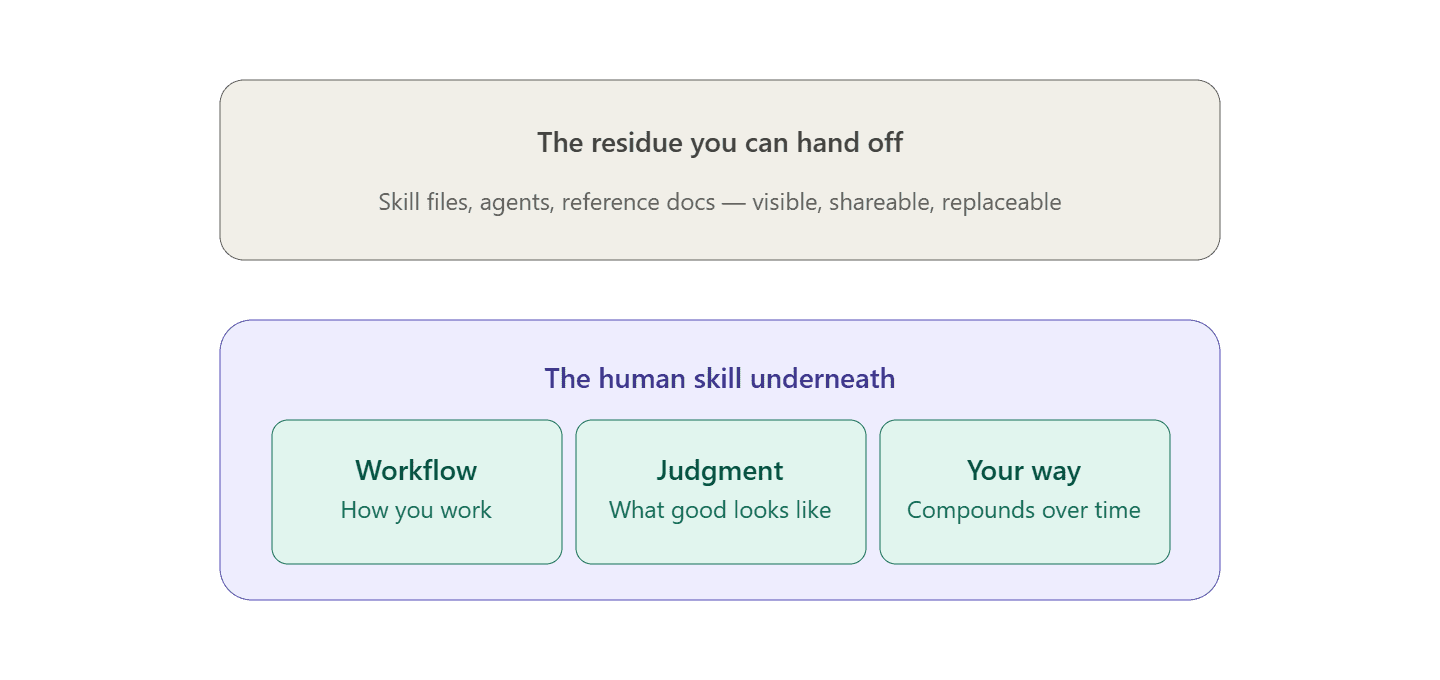
Learning to build agents, craft skills, and make systems productive isn't file authorship. It's the slow accumulation of a human skill — knowing how these tools actually behave, where they break, what to hand them and what to keep. The files are just where that knowledge gets written down.
And here's why it compounds rather than depreciates: as the models get better, the people who understand how they work get more valuable, not less. That runs against the intuition that better AI makes human judgment cheaper. It doesn't — not while the fundamental mechanic holds. These systems predict tokens; they don't understand. As long as that's true, the thing that actually matters is still yours. Your workflow. Your judgment. Your way of doing the thing. The model is fast and fluent; you're the one who knows what good looks like. That part doesn't come in the box.
The twenty-dollar library
Step back from the individual skill and the moment gets stranger. Knowledge that once took twenty people twenty years to accumulate now runs about twenty dollars a month.
You can see the consequence in who's shipping now. Non-technical builders — people who couldn't have written the backend a few years ago — have launched genuinely successful applications. The gate that used to be technical knowledge has largely come down. What's left standing on the other side is judgment about what to build and the discipline to make it work, which is exactly the human skill from the last section, now priced at twenty dollars and waiting.
Hold this loosely
One caution before the takeaway, because certainty here would be misplaced. The specific guidance can shift. New research — on memory, on how models index and retrieve information — could rewrite what counts as best practice. What reads as a rule today is really a snapshot of the current state, not permanent law. (I'd hold any recommendation in this space, including my own, with a light grip.)
So treat the tactics as provisional. The underlying move — build the human skill, let the files be the residue — is the part I'd bet stays.
Where it lands
Strip away the specifics and one message has held steady through all of it: less is more, simple is better.
There's a test buried in that principle, and it's the one I keep coming back to. If you can't explain something in a few sentences, you probably don't understand it yet. That's not a writing note — it's a diagnostic. The skill file you can't summarize is usually the one you overbuilt because your own thinking was still muddy. The clear explanation and the clean build tend to arrive together.
Which brings the whole thing full circle. The file I made last week wasn't the accomplishment. Being able to say what it does in two sentences was — because that meant I finally understood the workflow well enough to hand it over. The tools will keep improving. The guidance may shift. Either way, the part worth investing in is the one that stays with you when you close the laptop.
Published: