101s
Share:
Copy link
Copied!
I've been digging into Anthropic's Pitch Agent — one of ten reference agents they shipped for financial services — and the more I poke at it, the more it looks like a genuinely useful first-pass engine rather than another "AI writes your deck" pitch. Here's what it actually is, what it needs from you, how I'd validate its output, and a full run-through on a made-up mandate so you can see the whole arc.
The one-line version
An analyst who never sleeps, already knows your comps conventions and your firm's deck template, and runs the first pass the moment a mandate lands — so the team starts from a draft instead of a blank workbook.
That's the whole value prop. Not autonomous dealmaking (more on that in a second).
What's actually inside it
Three components working together: skills (the domain playbooks), connectors (governed pulls from your data providers), and subagents (narrow workers handling things like comp selection or a methodology check, so one model isn't doing everything in a single pass). Here's the shape of it, from mandate to a draft you actually sign off on.
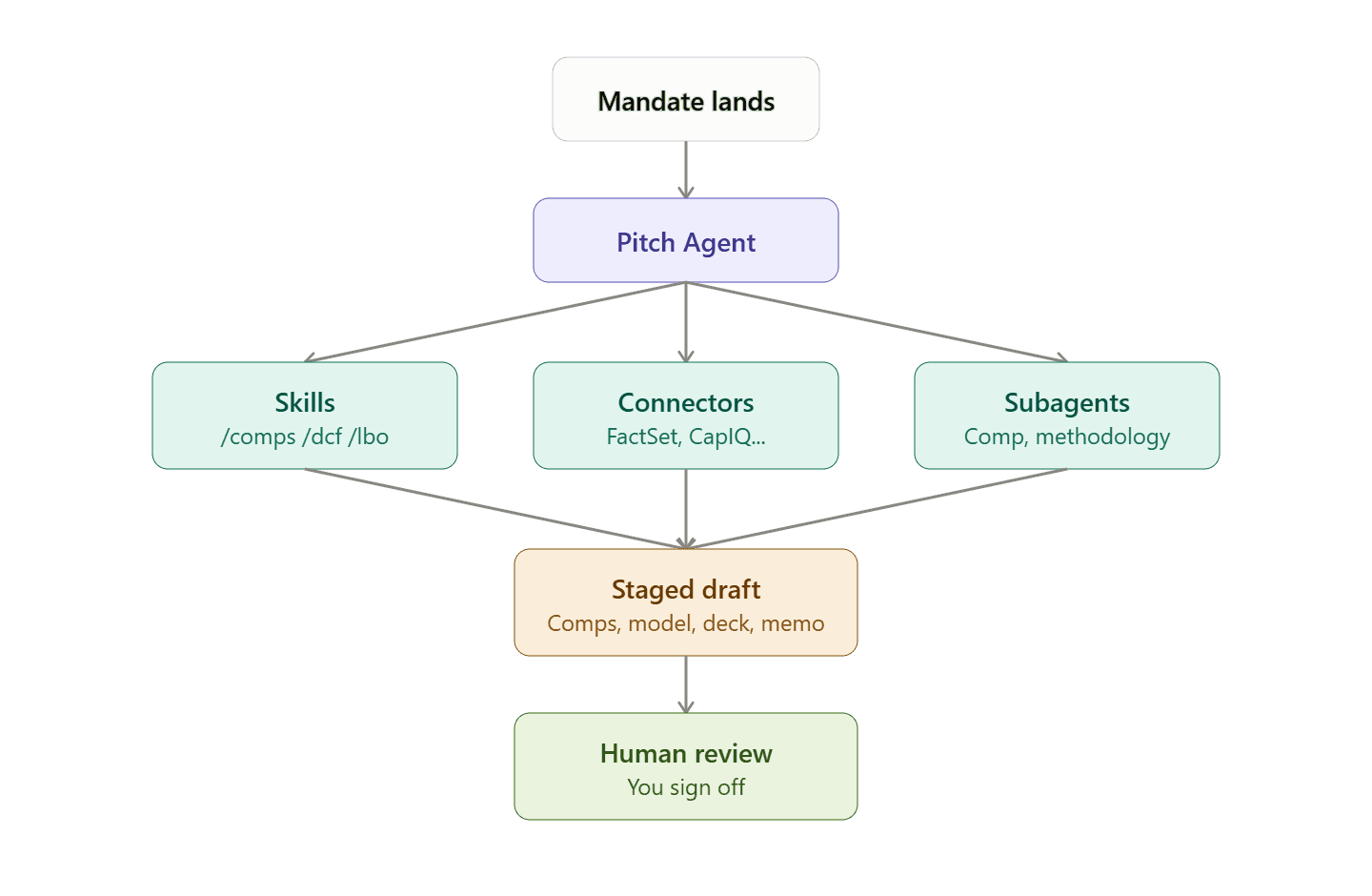
Runs two ways: as a Cowork/Claude Code plugin working the files already open on your desktop, or as a Managed Agent on Anthropic's platform for a whole coverage book or a nightly refresh. Either way, the governing line is the same — users stay firmly in the loop, reviewing and approving before anything goes to a client. Nothing sends itself. Nothing binds the firm. It drafts; you sign.
A worked example: the Friday-night sell-side ping
Let me make this concrete, because "it drafts a pitchbook" is the kind of sentence that sounds great and tells you nothing. Here's the shape of a run, on a fictional mandate.
The situation. It's 6pm Friday. You cover industrials. A managing director forwards you an email: a founder-owned specialty coatings business, ~$180M revenue, has signaled it might explore a sale, and the client — a mid-cap strategic — wants a preliminary view on valuation and whether it's worth pursuing. The MD wants something in front of the client Monday morning. Normally this is a lost weekend for two analysts.
Information gathered. Before anything useful happens, you feed the agent what it can't infer:
The mandate context — buy-side, strategic acquirer, target is private, ~$180M revenue, specialty coatings, founder-owned
A starting peer set you actually believe in — you name six public coatings and specialty-chemicals names rather than letting it guess, because you know which ones the client's board will recognize
The rough financials from the teaser the client already received — revenue, an EBITDA margin range, and a growth rate the founder is claiming
Your firm's PowerPoint template and the two credentials slides your group always leads with
Which multiples matter here — EV/EBITDA is the spine for this sector, not EV/Revenue
Everything else — pulling the public comps' trading multiples, precedent coatings transactions, a first-cut valuation range — the agent goes and gets or builds.
The step-by-step. What the run actually looks like, stage by stage:
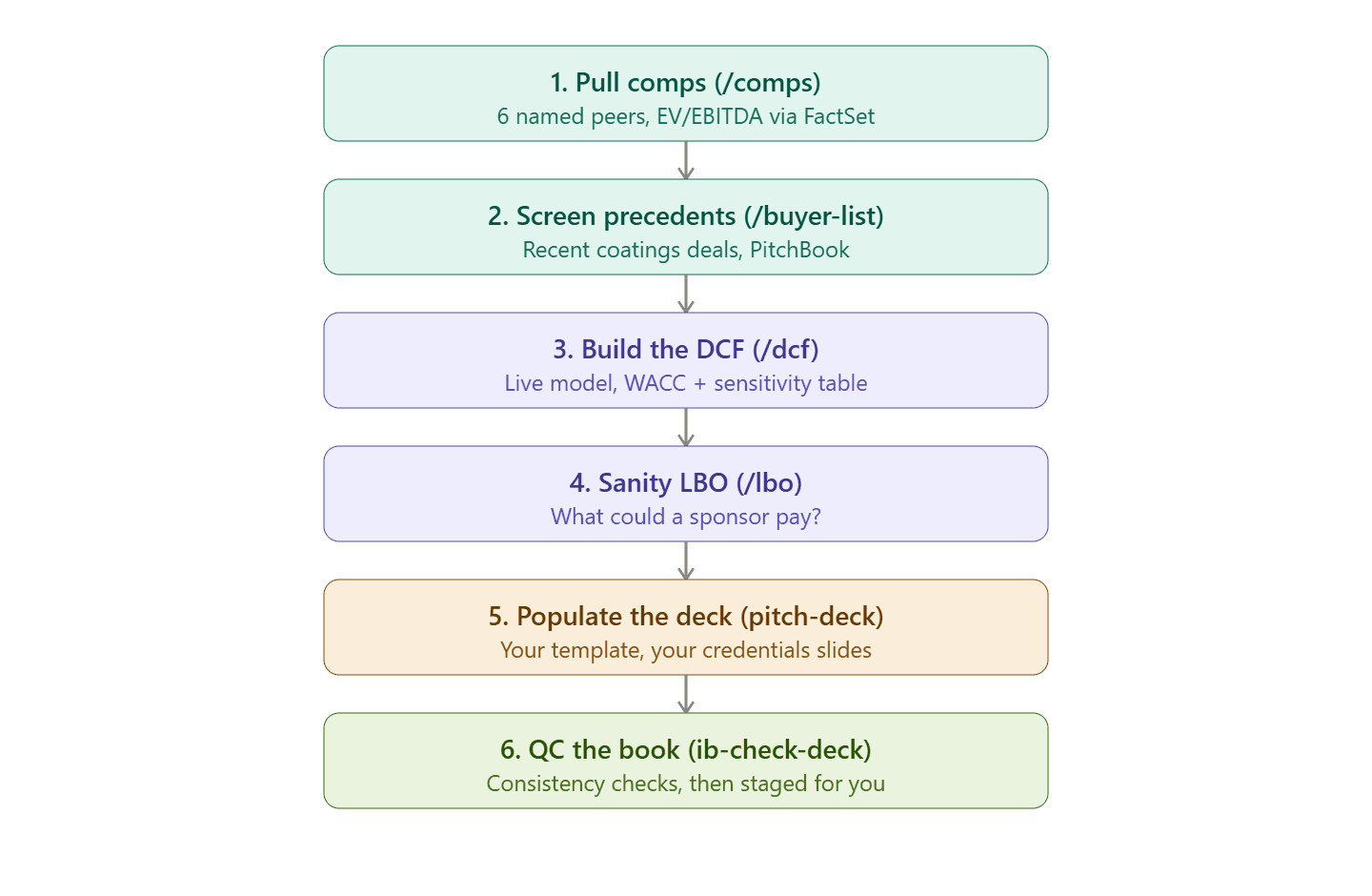
The output. By the time you sit back down with coffee, staged for review — not sent, not final — you've got:
An Excel comps sheet with your six named peers, EV/EBITDA multiples pulled live, and the target benchmarked against the set with a median and a range
A precedent transactions tab listing recent coatings deals with disclosed multiples, so the client can see where this sector actually clears
A live DCF workbook — revenue build, WACC off CAPM inputs, terminal value both ways, and a WACC × terminal-growth sensitivity table — producing a preliminary enterprise value range
A one-page LBO sanity check answering "what could a financial sponsor pay," which tells the strategic whether it'll be outbid before it spends real time
A populated pitchbook in your firm's template — situation overview, the football field stitching comps, precedents, and DCF into one valuation range, and your two credentials slides up front
A draft cover note in Outlook the MD can edit
What it did not do: decide the peer set (you did), decide the growth assumption (you fed it the founder's claim, and it's now sitting in the model waiting for you to stress it), or decide whether this deal is worth the client's time. That last call is the entire point of the meeting.
The part that actually matters: does it build a real model?
Yes. Claude writes live formulas instead of hardcoded numbers, recalculates the workbook, and verifies there are no formula errors before handing it back. In the coatings example, the DCF's WACC updates when you change beta, and the football field re-draws when you flex the exit multiple — it's a model, not a screenshot of one.
That debt schedule in the sanity LBO is exactly where these things quietly break, or get "fixed" with a plug that defeats the whole point of building it dynamically. So before that founder's growth claim goes anywhere near the client, here's the validation sequence I'd run.
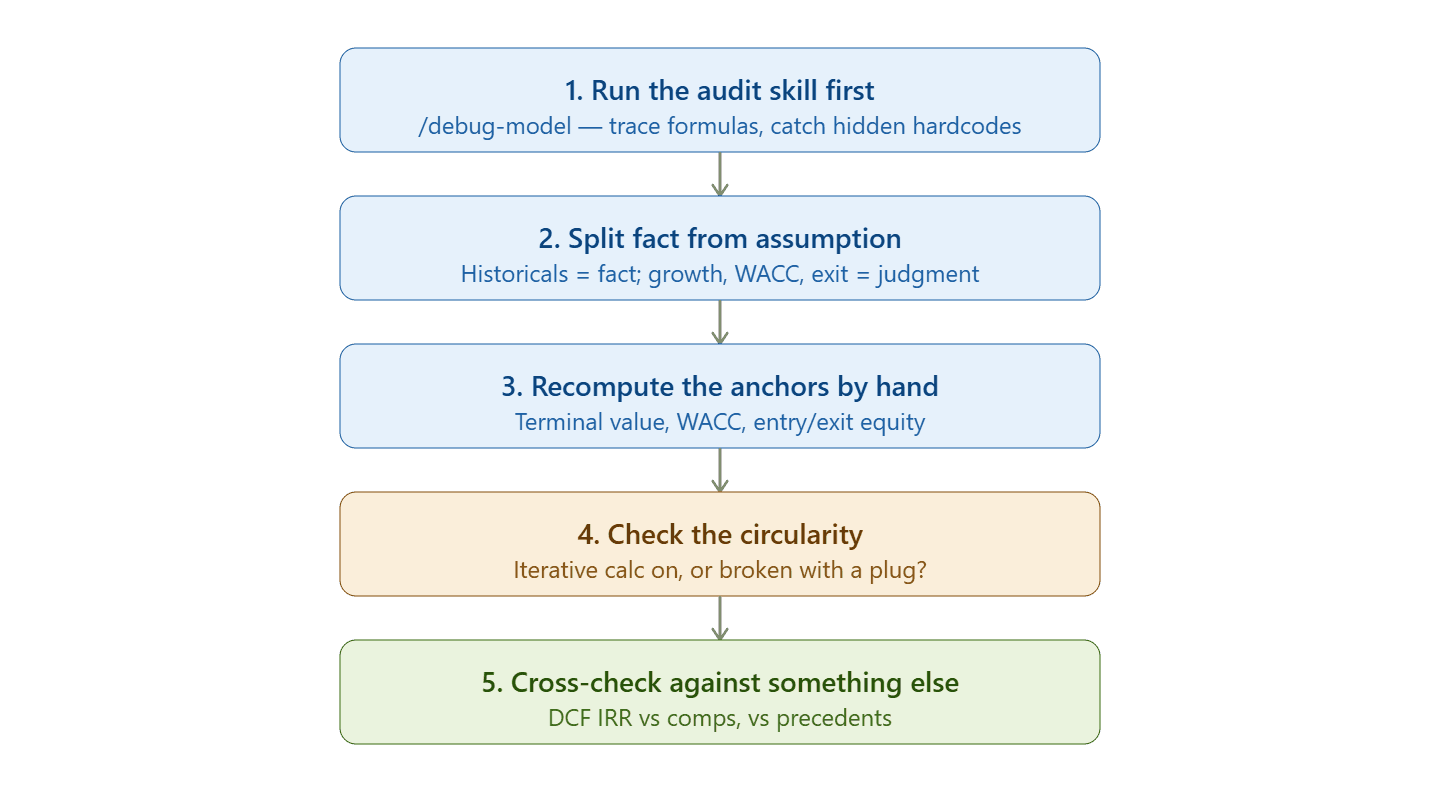
On the coatings deck, step 2 is the whole ballgame: the founder's growth number is a claim, not a fact, and it's now baked into your DCF's revenue build. If you skip that check and the client anchors on a valuation that only works at the founder's growth rate, that's your name on the football field, not the agent's.
"No formula errors" is necessary, not sufficient. A model can be internally airtight and still built on a growth number no IC would sit still for. The mechanics are Claude's job. Whether the assumptions survive the room is still yours — which, if you think about it, is basically the whole job description anyway.
Published: